[mashshare shares="true" align="left"]
Share on facebook
Share
Share on whatsapp
Share
Share on telegram
Share
(adsbygoogle = window.adsbygoogle || []).push({});

Micron Q2 2026 Earnings Highlights: 10 AI-Driven Signals Investors Shouldn’t Ignore

Micron Q2 2026 Earnings Highlights and AI Analysis

Micron Technology delivered one of the strongest earnings reports in semiconductor history during fiscal Q2 2026, powered by explosive AI demand, severe industry-wide memory shortages, and record profitability.

The company reported massive growth across DRAM, NAND, HBM, enterprise SSDs, and data center products while management repeatedly emphasized that AI is fundamentally reshaping the memory industry.

More importantly, Micron’s earnings transcript revealed several strategic insights that were barely mentioned in the official press release — including extreme supply shortages, structural industry changes, multi-year customer agreements, and expectations for elevated margins beyond 2026.

In this Micron earnings analysis, we break down the most important earnings highlights, guidance, and transcript insights investors should know.

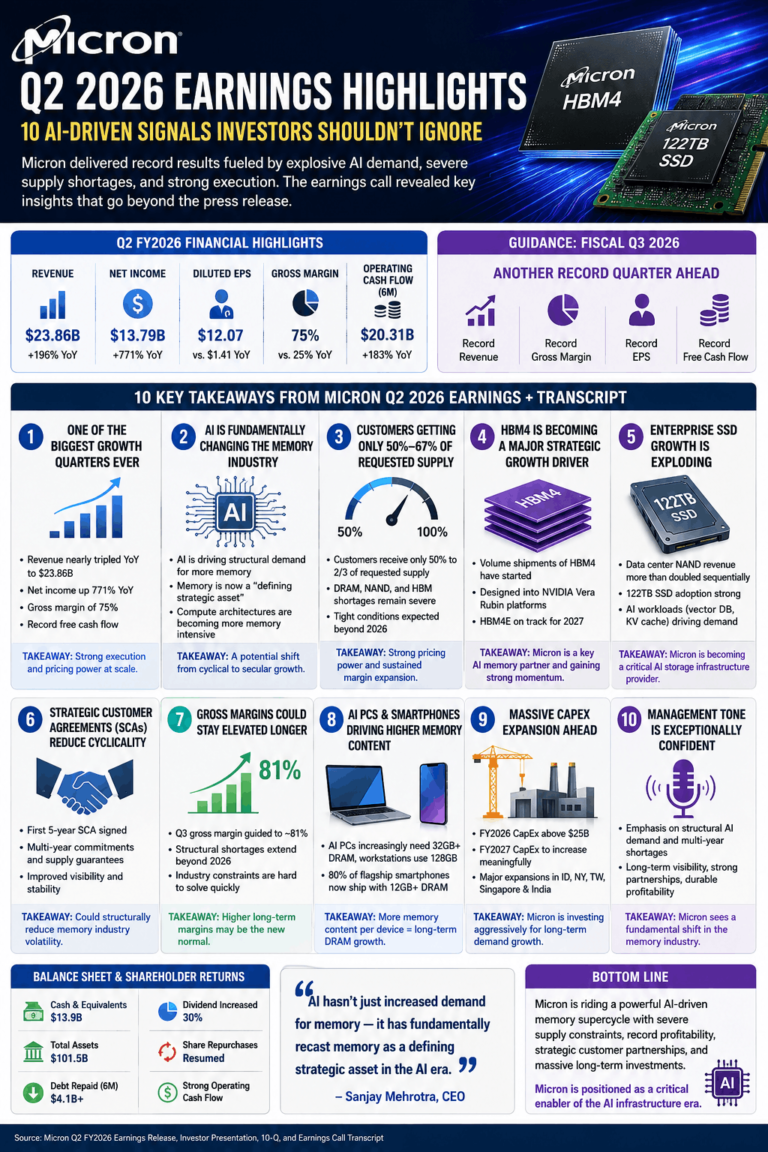
Micron reported extraordinary fiscal Q2 2026 financial results:

  • Revenue: $23.86 billion
  • Revenue growth: +196% YoY
  • Net income: $13.79 billion
  • Diluted EPS: $12.07 versus $1.41 last year
  • Gross margin: 75%
  • Operating income: $16.1 billion

The company also generated record free cash flow and record operating margins.

What stands out most is the scale of the acceleration. Quarterly revenue nearly tripled year over year as AI-driven memory demand surged across cloud, enterprise, and edge computing markets.

Investor interpretation:

This was not simply a cyclical recovery quarter. The scale of margin expansion and pricing power suggests Micron is benefiting from structural AI-driven demand changes.

Source: Micron Q2 FY2026 10-Q and investor presentation.

2. AI Is Fundamentally Changing the Memory Industry

Micron management repeatedly emphasized that AI has permanently altered the importance of memory.

CEO Sanjay Mehrotra stated:

“AI hasn’t just increased demand for memory — it has fundamentally recast memory as a defining strategic asset in the AI era.”

Management highlighted that modern AI systems require:

  • Larger memory pools
  • Faster memory bandwidth
  • Longer context windows
  • Multi-agent orchestration
  • More inference capacity

As AI workloads become increasingly memory intensive, Micron believes DRAM and NAND demand growth could remain elevated for years.

Investor interpretation:

This is potentially the most important takeaway from Micron’s earnings call. Management is signaling that the traditional boom-bust memory cycle may structurally improve due to AI.

3. Customers Are Receiving Only 50%–67% of Requested Supply

One of the most important transcript-only insights came during Q&A.

Micron disclosed that some customers are receiving only:

  • 50% to two-thirds of requested memory supply

This detail was not emphasized in the press release.

Management cited:

  • DRAM shortages
  • NAND shortages
  • HBM constraints
  • Cleanroom limitations
  • Long fab construction timelines

The company repeatedly stressed that supply-demand conditions are expected to remain tight beyond calendar 2026.

Investor interpretation:

This level of undersupply suggests:

  • Strong pricing power
  • Sustained elevated margins
  • Long-duration AI infrastructure demand

This may also explain why hyperscalers are increasingly willing to sign long-term agreements with Micron.

4. HBM4 Is Becoming a Major Strategic Growth Driver

Micron confirmed:

  • Volume shipments of HBM4 have started
  • Products are designed into NVIDIA Vera Rubin platforms
  • HBM4E development is already underway for 2027

The company also sampled:

  • HBM4 16-high products
  • 48GB HBM cubes
  • Advanced AI memory architectures

Importantly, Micron expects:

  • Faster yield ramps versus HBM3E
  • Greater customer customization opportunities
  • Deeper long-term AI partnerships

Investor interpretation:

HBM is becoming one of the most strategically valuable semiconductor categories in the AI ecosystem, and Micron appears increasingly competitive against Samsung and SK Hynix.

NVIDIA was repeatedly referenced throughout the earnings call as a major AI platform partner.

5. Enterprise SSD Growth May Be Underappreciated

Most investors focus on HBM, but Micron’s enterprise SSD business is quietly exploding.

Key highlights:

  • Data center NAND revenue more than doubled sequentially
  • Enterprise SSD market share increased for four consecutive years
  • 122TB SSD products are seeing strong adoption
  • AI workloads are driving storage acceleration

Micron specifically highlighted:

  • Vector database demand
  • KV cache offload
  • AI inference storage growth

The company also stated NAND demand is now:

“significantly in excess of available supply for the foreseeable future.”

Investor interpretation:

Micron is emerging not only as an AI memory winner, but also as a critical AI storage infrastructure supplier.

(adsbygoogle = window.adsbygoogle || []).push({});

6. Strategic Customer Agreements Could Reduce Memory Cyclicality

One of the most important developments in the transcript was Micron’s discussion of Strategic Customer Agreements (SCAs).

Micron announced:

  • Its first five-year SCA
  • Multiple ongoing negotiations with other customers

Unlike traditional one-year LTAs, these agreements include:

  • Multi-year commitments
  • Long-term supply guarantees
  • Capacity planning coordination
  • R&D collaboration
  • Greater pricing visibility

Management repeatedly emphasized that SCAs are designed to:

  • Improve stability
  • Reduce volatility
  • Strengthen customer partnerships

Investor interpretation:

This could become a major structural shift for the memory industry.

If hyperscalers increasingly lock in long-term memory supply contracts, the traditional memory cycle could become less volatile over time.

7. Gross Margins Could Stay Elevated Longer Than Investors Expect

Micron guided fiscal Q3 gross margins to approximately 81%, an extraordinary figure for a memory company.

Even more notable:

  • Management declined to suggest margins would normalize quickly
  • The company argued AI has structurally improved memory economics

CFO Mark Murphy said:

  • Memory is becoming more valuable
  • AI requires significantly more memory
  • Structural supply shortages are difficult to solve quickly

The company specifically cited:

  • HBM trade-ratio impacts
  • Declining bits-per-wafer improvements
  • Long greenfield fab build timelines
  • Cleanroom constraints

Investor interpretation:

Micron appears to believe this cycle could look very different from prior semiconductor memory cycles.

8. AI PCs and Smartphones Are Driving Higher Memory Content

Even though PC and smartphone unit growth may weaken, memory content per device is rising sharply.

Micron highlighted:

  • AI PCs increasingly requiring 32GB+ DRAM
  • Personal AI workstations using 128GB memory configurations
  • 80% of flagship smartphones now shipping with 12GB+ DRAM

The company also discussed:

  • Agentic AI PCs
  • On-device inference
  • AI-integrated mobile operating systems

Investor interpretation:

This supports long-term DRAM growth even if global device shipments remain sluggish.

AI may increase memory demand faster than unit growth slows.

(adsbygoogle = window.adsbygoogle || []).push({});

9. Micron Is Preparing for Massive Capacity Expansion

Micron’s future investment plans were far larger than many investors expected.

The company now expects:

  • Fiscal 2026 CapEx above $25 billion
  • Fiscal 2027 CapEx to increase meaningfully
  • Construction spending to rise by over $10 billion YoY in FY2027

Major manufacturing expansions include:

  • Idaho fabs
  • New York fabs
  • Taiwan expansion
  • Singapore NAND expansion
  • India assembly and test facilities

Investor interpretation:

Micron clearly believes AI-driven demand growth will persist for many years.

The company is aggressively scaling capacity to address long-term supply shortages.


10. Micron’s Tone Was More Confident Than Any Prior Memory Cycle

Perhaps the biggest difference versus previous memory cycles was management tone.

Historically, memory executives have been cautious about:

  • Margin durability
  • Long-term pricing
  • Supply-demand visibility

This quarter was different.

Micron repeatedly emphasized:

  • Structural AI demand
  • Multi-year shortages
  • Long-term customer commitments
  • Durable profitability
  • Secular memory growth

Management sounded less like a cyclical commodity company and more like a critical AI infrastructure provider.

Investor interpretation:

Whether this proves sustainable remains to be seen, but Micron clearly believes the AI era has fundamentally changed the memory market.

Conclusion

Micron’s Q2 2026 earnings report may ultimately be remembered as a turning point for the memory industry.

The company delivered:

  • Record revenue
  • Record margins
  • Record free cash flow
  • Record HBM growth
  • Record NAND performance

But the most important insights came from the earnings transcript itself.

Micron management made it increasingly clear that:

  • AI demand is overwhelming industry supply
  • Customers are seeking multi-year supply guarantees
  • Memory intensity is accelerating rapidly
  • Structural shortages may persist for years

If these trends continue, Micron could become one of the biggest long-term beneficiaries of the global AI infrastructure buildout.

Thank you for reading this post. If you enjoy this post, please share it with your friends or family members. Let’s get life transformed together! Many thanks.

Share on facebook
Share
Share on whatsapp
Share
Share on telegram
Share
(adsbygoogle = window.adsbygoogle || []).push({});

Leave a Reply

Your email address will not be published. Required fields are marked *

Trending Posts

Copyright 2021 © MR Life Changer | Powered by www.mrlifechanger.com

For business collaboration/enquiries, please contact: mr.life.changer9@gmail.com