[mashshare shares="true" align="left"]
Share on facebook
Share
Share on whatsapp
Share
Share on telegram
Share
(adsbygoogle = window.adsbygoogle || []).push({});

10 Key Takeaways From TNB FY2025 Earnings: Data Centre Growth, Higher Dividends and Massive RP4 CAPEX Expansion

TNB FY2025 Earnings Highlights and Growth Analysis

Tenaga Nasional Berhad (TNB) delivered a strong FY2025 earnings result, driven by accelerating electricity demand, higher regulated returns under RP4, and rising data centre investments in Malaysia. While the official earnings release highlighted revenue growth and stronger profitability, the analyst call revealed several deeper insights that could materially shape TNB’s long-term earnings outlook.

From contingent CAPEX recognition improvements to AI-driven data centre demand and ASEAN power grid opportunities, TNB appears to be transitioning from a traditional utility into a regional energy infrastructure platform.

Here are the 10 most important takeaways from TNB’s FY2025 earnings results and analyst transcript.

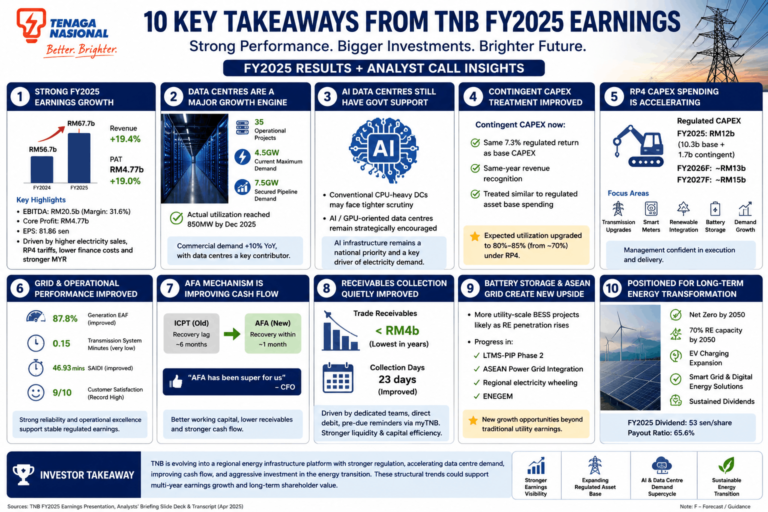
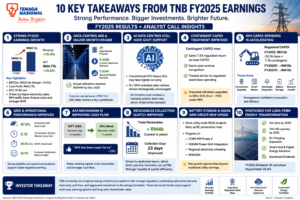
TNB reported FY2025 revenue of RM67.7 billion, up 19.4% year-over-year, while profit after tax climbed 19.0% to RM4.77 billion.

Key financial highlights included:

  • EBITDA increased to RM20.5 billion
  • EBITDA margin improved to 31.6%
  • Core profit rose to RM4.77 billion
  • EPS increased to 81.86 sen

The strong performance was driven by:

  • higher electricity sales
  • implementation of RP4 tariffs
  • lower finance costs
  • forex gains from stronger MYR against USD and JPY

Importantly, management emphasized that operational improvements — not just forex gains — were the primary earnings driver.

For investors, this signals improving earnings quality and stronger operational execution across TNB’s regulated business.

2. Data Centres Are Becoming a Major Structural Growth Engine

One of the biggest themes from the analyst call was the rapid growth of Malaysia’s data centre industry.

TNB disclosed:

  • 35 operational data centre projects
  • 4.5GW current maximum demand
  • 7.5GW cumulative secured pipeline

Management also revealed actual data centre load utilization reached 850MW by December 2025, showing projects are increasingly moving into commercial operation.

Commercial electricity demand grew 10% YoY, with data centres contributing a meaningful portion of incremental growth.

This matters because AI and cloud infrastructure require:

  • high electricity intensity
  • premium grid reliability
  • long-duration contracts

These trends could create a multi-year electricity demand supercycle for TNB.

3. AI-Focused Data Centres Still Have Government Support

During the Q&A session, management addressed investor concerns about reports suggesting Malaysia may slow new data centre approvals.

TNB clarified that:

  • conventional CPU-heavy data centres may face tighter scrutiny
  • AI/GPU-oriented data centres remain strategically encouraged

Management specifically indicated that AI infrastructure aligned with national priorities continues to receive support.

This distinction is important because AI data centres:

  • consume significantly more electricity
  • create higher grid demand density
  • require larger transmission investments

For TNB, AI-related infrastructure could become one of the most valuable long-term demand drivers.

4. Contingent CAPEX Recognition Is a Major Regulatory Win

One of the most important transcript-only revelations was the new treatment of contingent CAPEX.

Historically, investors worried contingent CAPEX:

  • lacked visibility
  • had delayed recognition
  • carried uncertain returns

Management clarified that contingent CAPEX now:

  • earns the same 7.3% regulated return as base CAPEX
  • receives same-year revenue recognition
  • is effectively treated similarly to regulated asset base spending

This is a major improvement in earnings visibility.

TNB now expects:

  • 80%–85% utilization of contingent CAPEX under RP4
  • versus previous expectations of around 70%

This could materially increase future regulated earnings growth.

5. RP4 CAPEX Spending Is Accelerating Aggressively

TNB deployed RM12 billion of regulated CAPEX in FY2025:

  • RM10.3 billion base CAPEX
  • RM1.7 billion contingent CAPEX

Management guided:

  • FY2026 regulated CAPEX around RM13 billion
  • FY2027 regulated CAPEX around RM15 billion

The investments focus on:

  • transmission upgrades
  • smart meters
  • renewable integration
  • battery storage
  • demand growth infrastructure

Importantly, management strongly emphasized execution capability, stating that these investment plans are operationally achievable.

This matters because expanding regulated asset base directly supports long-term earnings compounding for utilities.

(adsbygoogle = window.adsbygoogle || []).push({});

6. TNB’s Grid and Operational Performance Improved Significantly

Operational reliability improved materially in FY2025.

Key metrics included:

  • Generation EAF improved to 87.8%
  • Transmission system minutes remained extremely low at 0.15
  • SAIDI improved to 46.93 minutes

Management highlighted that:

  • plant turnaround initiatives are working
  • network reliability remains world class
  • customer satisfaction reached a record 9/10 score

These improvements support:

  • regulated earnings stability
  • lower operational disruptions
  • stronger customer sentiment

The improved customer satisfaction score was particularly notable because management rarely emphasizes soft operational metrics unless they reflect meaningful operational progress.

7. The New AFA Mechanism Is Improving Cash Flow

The analyst call revealed that TNB’s new Automatic Fuel Adjustment (AFA) mechanism is materially improving cash flow.

Previously, under ICPT:

  • fuel cost recovery lagged by six months

Under AFA:

  • recovery occurs within one month

Management stated this has:

  • improved working capital
  • reduced receivables
  • enhanced cash flow planning

The CFO described AFA as:

“super for us”

This change may appear technical, but it significantly improves cash conversion efficiency — historically one of the utility sector’s weaker areas.

8. TNB Quietly Improved Receivables Collection

One of the more overlooked operational achievements was TNB’s improved receivables management.

Trade receivables declined below RM4 billion for the first time in years, while collection days improved to 23 days.

Management explained several operational initiatives behind this:

  • dedicated collection teams for large customers
  • direct debit migration
  • pre-due reminders via myTNB app

This matters because TNB is simultaneously scaling CAPEX aggressively.

Stronger collections improve:

  • liquidity
  • borrowing flexibility
  • dividend sustainability
  • capital efficiency

This operational discipline was not prominently highlighted in the official earnings release.

(adsbygoogle = window.adsbygoogle || []).push({});

9. Battery Storage and ASEAN Power Grid Could Create New Growth Opportunities

TNB is increasingly positioning itself as a regional energy infrastructure platform.

The company highlighted progress in:

  • LTMS-PIP Phase 2
  • ASEAN power grid integration
  • regional electricity wheeling
  • Energy Exchange Malaysia (ENEGEM)

Management also hinted that:

  • more utility-scale battery storage projects are likely coming
  • battery deployment will scale progressively with renewable penetration

Battery storage could become a significant future regulated CAPEX opportunity as Malaysia expands renewable energy capacity.

Meanwhile, ASEAN interconnection projects may create:

  • new transmission revenue streams
  • cross-border energy trading opportunities
  • regional strategic positioning

10. TNB Is Positioning for Long-Term Energy Transition Growth

The broader message from management was clear:
TNB is no longer just a traditional electricity utility.

The company is building capabilities across:

  • renewable energy
  • smart grids
  • battery storage
  • EV charging
  • regional interconnection
  • AI data centre infrastructure

Key long-term targets include:

  • Net Zero by 2050
  • 70% renewable energy capacity by 2050
  • accelerated electrification
  • smarter digital energy platforms

Management also reiterated its commitment to sustaining dividend payouts while continuing heavy investment.

FY2025 dividend totaled:

  • 53 sen per share
  • 65.6% payout ratio

This suggests management remains confident in cash flow generation despite elevated CAPEX spending.

Conclusion

TNB’s FY2025 earnings results revealed much more than headline profit growth.

The analyst call highlighted several important structural themes:

  • accelerating AI-driven electricity demand
  • improving regulatory clarity
  • expanding regulated asset base
  • better cash flow mechanics
  • growing ASEAN energy integration opportunities

The most important takeaway may be that TNB is evolving into a regional energy infrastructure and electrification platform rather than remaining a conventional utility company.

If Malaysia’s data centre and energy transition ambitions continue accelerating, TNB could benefit from:

  • sustained electricity demand growth
  • larger regulated returns
  • stronger earnings visibility
  • long-duration infrastructure monetization opportunities.

Thank you for reading this post. If you enjoy this post, please share it with your friends or family members. Let’s get life transformed together! Many thanks.

Share on facebook
Share
Share on whatsapp
Share
Share on telegram
Share
(adsbygoogle = window.adsbygoogle || []).push({});

Leave a Reply

Your email address will not be published. Required fields are marked *

Trending Posts

Copyright 2021 © MR Life Changer | Powered by www.mrlifechanger.com

For business collaboration/enquiries, please contact: mr.life.changer9@gmail.com