[mashshare shares="true" align="left"]
Share on facebook
Share
Share on whatsapp
Share
Share on telegram
Share
(adsbygoogle = window.adsbygoogle || []).push({});

Intel Q1 2026 Earnings Highlights: 12 Hidden AI Growth Signals Investors Shouldn’t Ignore

Intel Q1 2026 Earnings Highlights and AI Growth Analysis

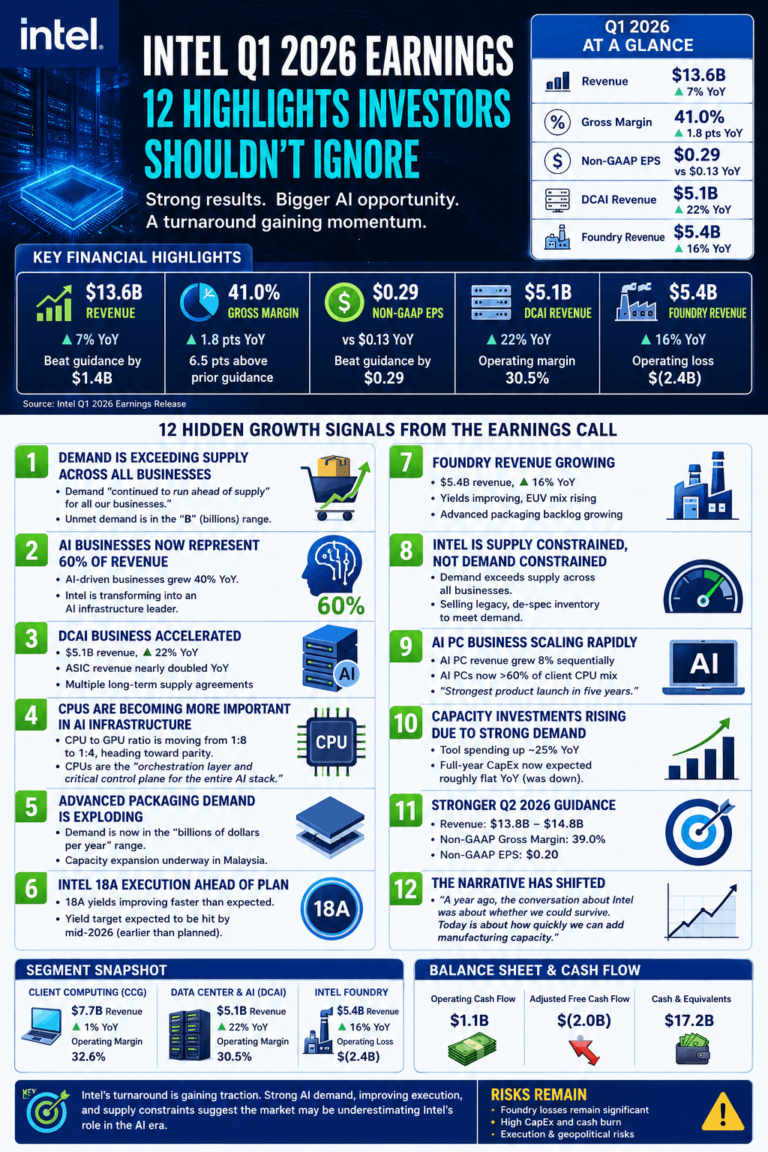
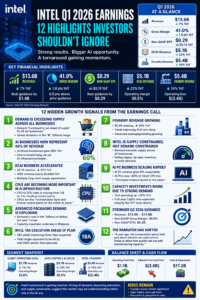
Intel delivered one of its strongest earnings reports in years, signaling that the company’s turnaround strategy may finally be gaining traction. While Intel’s Q1 2026 earnings release showed solid revenue growth, improving margins, and stronger guidance, the earnings transcript revealed much deeper insights about AI infrastructure demand, CPU market dynamics, advanced packaging growth, and foundry momentum.

The combination of accelerating AI workloads, improving Intel 18A execution, and stronger-than-expected demand paints a very different picture of Intel than investors saw just a year ago.

In this Intel earnings analysis, we break down the most important earnings highlights, transcript insights, and growth signals that investors may be underestimating.

ntel reported:

  • Q1 2026 revenue of $13.6 billion
  • Revenue growth of 7% year-over-year
  • Revenue exceeding guidance by $1.4 billion.

Management noted this marked Intel’s:

  • sixth consecutive quarter beating expectations.

The biggest surprise was not simply the revenue growth itself, but management’s disclosure that demand significantly exceeded available supply.

Investor Interpretation

This suggests Intel’s operational recovery is becoming real rather than theoretical.

2. Intel Says AI Businesses Now Represent 60% of Revenue

One of the most important transcript disclosures was:

“Our collective AI-driven businesses now represent 60% of revenue and grew 40% year-over-year.”

This statement never appeared prominently in the earnings release.

Intel’s AI exposure now spans:

  • Xeon server CPUs
  • AI PCs
  • ASIC infrastructure
  • Advanced packaging
  • Foundry services
  • Edge AI systems

Why It Matters

The market still often views Intel as a legacy PC company, but management is positioning Intel as an AI infrastructure company.

3. Intel’s Data Center & AI Business Accelerated Sharply

Intel’s DCAI segment produced:

  • Revenue of $5.1 billion
  • Growth of 22% YoY
  • Operating margin of 30.5%.

Management also disclosed:

  • ASIC revenue nearly doubled YoY
  • Strong demand across hyperscaler customers
  • Multiple long-term supply agreements.

Intel specifically highlighted partnerships with:

  • Google
  • NVIDIA
  • SambaNova.

Investor Interpretation

This was arguably the strongest part of Intel’s earnings report and signals the company is participating more deeply in the AI infrastructure buildout.

4. CPUs Are Becoming More Important in AI Infrastructure Again

Perhaps the biggest strategic insight from the transcript was Intel’s claim that CPUs are regaining importance in AI systems.

Lip-Bu Tan stated:

“The ratio of CPU to GPUs used to be one and eight, and now it’s one to four, and I think towards parity or even better.”

Intel argues:

  • AI inference
  • agentic AI
  • physical AI
  • edge AI

all require significantly more CPU orchestration.

Why This Matters

This challenges the dominant market narrative that AI growth benefits only GPU vendors.

Intel believes CPUs will remain foundational for:

  • memory orchestration,
  • networking,
  • inference coordination,
  • and AI agent management.

Investor Interpretation

Potentially one of the most important long-term AI infrastructure trends.

5. Intel’s Advanced Packaging Business Is Exploding

Intel disclosed:

  • growing advanced packaging backlog,
  • rising customer demand,
  • and capacity expansion in Malaysia.

But the transcript revealed something much bigger.

David Zinsner stated:

“Demand is more in the billions of dollars per year kind of level.”

Intel originally expected packaging opportunities in the hundreds of millions.

Why It Matters

Advanced packaging is becoming one of the most strategically valuable parts of semiconductor manufacturing.

Investor Interpretation

Advanced packaging could become:

  • one of Intel Foundry’s highest-margin businesses,
  • and one of Intel’s fastest-growing AI revenue streams.
(adsbygoogle = window.adsbygoogle || []).push({});

6. Intel 18A Execution Appears Ahead of Schedule

Intel repeatedly emphasized improving manufacturing execution.

Management disclosed:

  • Intel 18A yields improved faster than expected
  • Intel 14A progress is ahead of plan
  • cycle times are improving.

David Zinsner revealed:

“We’re probably going to hit that [yield target] in the middle of this year.”

Why It Matters

Intel’s manufacturing delays have damaged investor confidence for years.

This quarter may represent a major execution inflection point.

Investor Interpretation

Bullish if execution continues improving throughout 2026.

7. Intel Foundry Revenue Grew 16% YoY

Intel Foundry reported:

  • Revenue of $5.4 billion
  • Growth of 16% YoY.

The business still lost:

  • $(2.4) billion operating income.

However, management emphasized:

  • improving yields,
  • increasing EUV mix,
  • stronger advanced packaging backlog,
  • and growing external customer engagement.

Investor Interpretation

The foundry turnaround remains early-stage, but operational progress is becoming increasingly visible.

8. Intel Is Supply Constrained, Not Demand Constrained

One of the strongest hidden messages from the transcript was Intel’s inability to fully meet demand.

Lip-Bu Tan said:

“Demand continued to run ahead of supply for all our businesses.”

David Zinsner later implied unmet demand may measure in billions of dollars.

Intel also disclosed it:

  • sold legacy inventory,
  • utilized de-spec products,
  • and accelerated output aggressively to satisfy customers.

Why It Matters

This is a dramatic shift from Intel’s narrative over the past several years.

Investor Interpretation

Potentially one of the most bullish hidden signals from the entire earnings call.

(adsbygoogle = window.adsbygoogle || []).push({});

9. Intel’s AI PC Business Is Scaling Rapidly

Intel stated:

  • AI PC revenue grew 8% sequentially
  • AI PCs now exceed 60% of client CPU mix.

The company also called Core Ultra Series 3:

  • “the strongest product launch in five years.”

Why It Matters

Intel is positioning AI PCs as:

  • a replacement cycle catalyst,
  • a pricing driver,
  • and a margin expansion opportunity.

Investor Interpretation

AI PC adoption could help stabilize Intel’s client business after several difficult years.

10. Intel Raised Capacity Investments Because Demand Is Stronger

Intel changed its full-year capital spending expectations from:

  • “flat to down”
    to:
  • roughly flat year-over-year.

Tool spending alone is expected to rise approximately:

  • 25% YoY.

Why It Matters

Intel is aggressively expanding wafer output capacity.

Management now sees enough committed demand to justify higher investment.

Investor Interpretation

Bullish for long-term growth, though potentially negative for short-term free cash flow.

11. Intel Issued Stronger Q2 Guidance

Intel guided:

  • Q2 revenue: $13.8B–$14.8B
  • Non-GAAP gross margin: 39.0%
  • Non-GAAP EPS: $0.20.

At the midpoint:

  • revenue would grow approximately 10% YoY,
  • while EPS improves by roughly $0.30 YoY.

Investor Interpretation

The guidance reinforced management’s confidence in sustained AI infrastructure demand.

12. Intel’s Entire Narrative Has Changed

Perhaps the most revealing quote from the transcript came from CEO Lip-Bu Tan:

“A year ago, the conversation about Intel was about whether we could survive. Today is about how quickly we can add manufacturing capacity.”

That single statement captures the magnitude of Intel’s strategic shift.

The market narrative around Intel may now be transitioning from:

  • turnaround uncertainty
    to:
  • execution and capacity scaling.

Conclusion

Intel’s Q1 2026 earnings results delivered much more than a standard quarterly beat.

The earnings release showed:

  • stronger revenue,
  • improving margins,
  • accelerating DCAI growth,
  • and stronger guidance.

But the earnings transcript revealed something far more important:

  • AI infrastructure demand is accelerating,
  • CPUs are regaining strategic relevance,
  • advanced packaging demand is surging,
  • and Intel may now be constrained by supply rather than demand.

The biggest takeaway from Intel’s earnings analysis is that the company’s turnaround appears increasingly operational rather than aspirational.

Risks still remain:

  • Foundry profitability remains deeply negative,
  • capital intensity remains high,
  • and execution risk is not fully eliminated.

However, Intel’s Q1 2026 earnings call may ultimately be remembered as the quarter where investors began reassessing Intel’s role in the AI era.

Thank you for reading this post. If you enjoy this post, please share it with your friends or family members. Let’s get life transformed together! Many thanks.

Share on facebook
Share
Share on whatsapp
Share
Share on telegram
Share
(adsbygoogle = window.adsbygoogle || []).push({});

Leave a Reply

Your email address will not be published. Required fields are marked *

Trending Posts

Copyright 2021 © MR Life Changer | Powered by www.mrlifechanger.com

For business collaboration/enquiries, please contact: mr.life.changer9@gmail.com