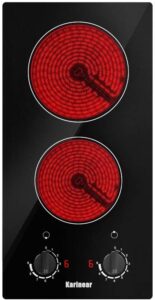
The power and electricity consumption of an induction cooktop depends on number of burners, how long you use it and its watts specified on the device. Nowadays, there are induction cookers with either four or two or one burners in Singapore. The more burners you always use daily, the more electricity a cooktop consumes, the higher its electricity consumption is. For example, if a label on the device mentions 4kW and you use it for one hour, then it will use 4 units of electricity.
In 2026, with electricity tariffs and GST rates shifting, calculating your exact running cost is more important than ever. When you’re looking to buy an induction cooker in Singapore, kindly make sure to check its label or its production description and specification with the maximum power consumption. Every induction cooker has a label with a maximum consumption power. If you want to measure the estimated electricity consumed by any electrical device including an induction cooktop, you can use this electricity usage monitor.
According to the research conducted by the US Department of Energy, the study found that induction cookers are 70.7-71.9% efficiency whereas the gas ones are only 43.9%. This study suggests that induction cooking is a more efficient way to gas cooking. The most of heat energy generated by induction cooking is used for cooking. In comparison, with gas stoves only 40%-50% of the heat is used for actual cooking. Due to efficiency, faster and easier to keep clean, induction cookers tend to be more expensive than gas cookers.
Refer to SP Group electricity tariff and gas tariff in Singapore, you will notice the gas tariff is cheaper than electricity tariff.
Because of the quick cooking time and minimal heat lost, the induction cooking technology is worth spending a bit of your electricity on.
When calculating electricity costs, we must look at the current regulated tariff provided by SP Group.
Current Electricity Tariff (Q1 2026): $0.2911 / kWh (inclusive of 9% GST).
Note: This is a significant adjustment compared to previous years. If you are on an Open Electricity Market (OEM) plan with retailers like Geneco or Keppel, your rate might be slightly lower, but this serves as the standard baseline.
The wattage of these cookers range from 1,000 watts to 7,200 watts depending on the size of surface area of burner in inch and number of burners.
If the higher watt device heats up more quickly than the lower watt device, then it will take less time to cook. Generally, a higher-wattage induction cooker will consume more electricity than a lower-wattage induction cooker.
In Singapore, there are a variety of induction cookers available, such as one-burner induction cookers, 2-burner/4-burner/5-burner cookers. The more burners you use at the same time, the more power the cooker consumes, the higher electricity is.
This is the most common question we get: “Gas tariffs are cheaper, so why switch?”
Let’s look at the 2026 comparison:
Town Gas Tariff (City Energy): Approx. $0.2363 / kWh (inc. GST).
Electricity Tariff (SP Group): Approx. $0.2911 / kWh (inc. GST).
On paper, gas looks cheaper. However, efficiency is the key.
Gas Efficiency (~40%): When you burn gas, nearly 60% of the heat escapes into your kitchen air. You are paying for heat that doesn’t cook your food.
Induction Efficiency (~90%): Induction uses electromagnetic fields to heat the pot directly. Very little energy is wasted.
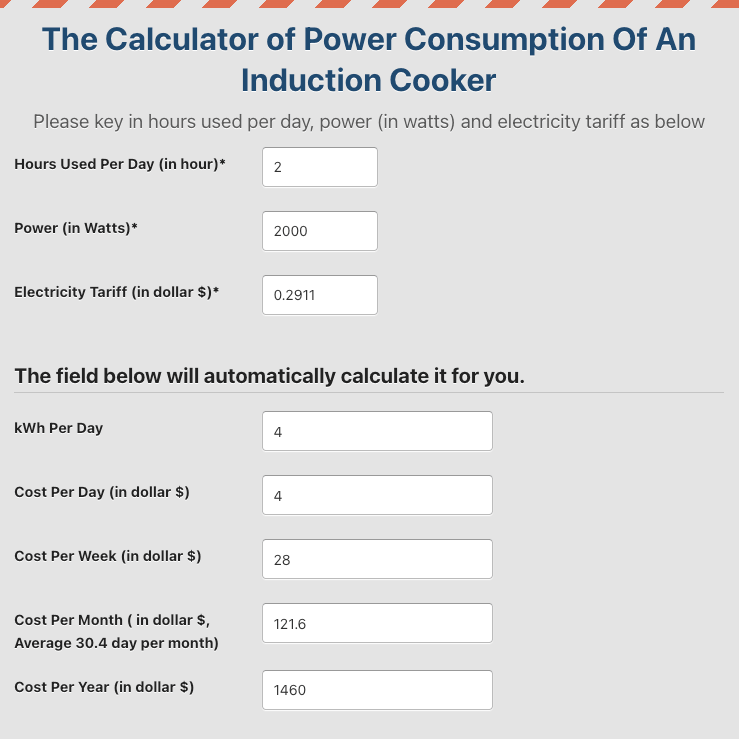
On average, an induction cooker uses approximately 2,000 watts for 2 hours daily.
Let’s key in the number of usage hours per day, the power in wattage and electricity tariff as S$0.2255 /KWh refer to SP Group information.
Here’s the result as shown below. There are kWh per day, cost per day, cost per week, cost per month and cost per year.
If you want to calculate how much electricity your induction cooker uses, you can use this FREE calculator.
Does an induction cooker consume a lot of electricity? Let’s look at the math for a typical Singaporean family.
The Scenario:
Device: A standard induction cooker (approx. 2,000 Watts or 2kW).
Usage: You cook for 2 hours daily (lunch and dinner).
The Math:
Energy Used: 2kW × 2 hours = 4 kWh (units) per day.
Daily Cost: 4 kWh × $0.2911 = ~$1.16 per day.
Monthly Cost: ~$1.16 × 30 days = ~$34.80 per month.
Thank you for reading this post. If you enjoy this post, please share it with your friends or family members. Let’s get life transformed together! Many thanks.
Trending Posts


12 Things You Need to Know About UnitedHealth Group’s Q3 2025 Earnings (And the “Hidden” Bombshells)


LVMH Q3 2025 Earnings Explained: Key Highlights, Guidance, and Real Insights


Hermès Q3 2025 Earnings Explained Simply: What Really Matters for Investors


Salesforce FY26 Q3 Earnings Explained: Key Highlights Beyond the Slides


TSMC Q4 2025 Earnings Review: Financial Highlights and Hidden Insights from the Transcript
Trending Posts


12 Things You Need to Know About UnitedHealth Group’s Q3 2025 Earnings (And the “Hidden” Bombshells)


LVMH Q3 2025 Earnings Explained: Key Highlights, Guidance, and Real Insights


Hermès Q3 2025 Earnings Explained Simply: What Really Matters for Investors


Salesforce FY26 Q3 Earnings Explained: Key Highlights Beyond the Slides


TSMC Q4 2025 Earnings Review: Financial Highlights and Hidden Insights from the Transcript


Alphabet Q3 2025 Earnings: What the Slides Miss and the Transcript Reveals About AI Growth


Microsoft FY25 Q3 Earnings: Why Azure and AI Are Stronger Than The Numbers Show


NVIDIA Q3 FY2026 Earnings: What the Slides Did Not Tell You About the AI Supercycle


NVIDIA CES 2026 Highlights: Robots, AI Agents and the Vera Rubin Supercomputer
Copyright 2021 © MR Life Changer | Powered by www.mrlifechanger.com
For business collaboration/enquiries, please contact: mr.life.changer9@gmail.com