[mashshare shares="true" align="left"]
Share on facebook
Share
Share on whatsapp
Share
Share on telegram
Share
(adsbygoogle = window.adsbygoogle || []).push({});
UnitedHealth (UNH) Q2 2026 Earnings: 13 Key Takeaways & 2026 Guidance

UnitedHealth (UNH) Q2 2026 Earnings: 13 Key Takeaways & 2026 Guidance

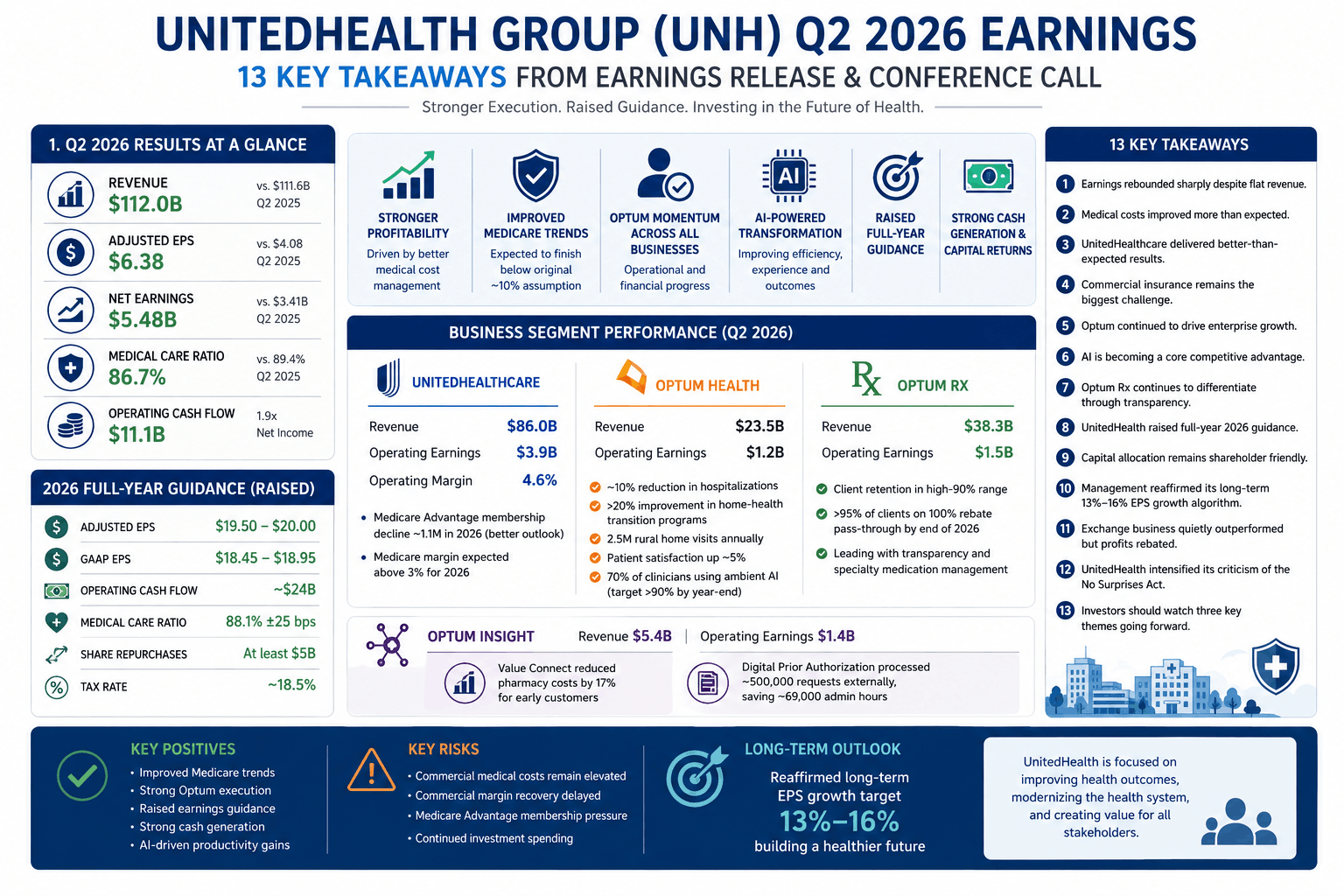
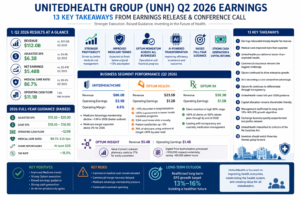
UnitedHealth Group delivered a stronger-than-expected second quarter, raising its full-year guidance while demonstrating meaningful operational improvement across UnitedHealthcare and Optum. Beyond the headline numbers, management also used the earnings call to provide valuable insights into commercial healthcare cost pressures, AI-driven transformation, and the company’s long-term growth strategy. Here are the 13 biggest takeaways.

UnitedHealth reported Q2 2026 revenue of $112.0 billion, essentially flat compared with last year, but profitability improved significantly.

Highlights include:

  • Adjusted EPS: $6.38
  • GAAP EPS: $6.04
  • Net earnings: $5.48 billion
  • Operating earnings: $8.0 billion
  • Operating cash flow: $11.1 billion

The strong earnings growth demonstrates that management’s pricing actions, portfolio adjustments, and operational improvements are beginning to translate into better profitability.

2. Medical Costs Improved Much More Than Expected

One of the quarter’s biggest positives was the Medical Care Ratio (MCR).

The MCR improved to:

86.7%

compared with

89.4%

a year ago.

Management attributed the improvement to:

  • Better benefit design
  • Improved care management
  • Network optimization
  • Favorable prior-period reserve development
  • A milder respiratory season and weather impacts

On the earnings call, executives further disclosed that Medicare medical trends are now expected to finish below the original 10% planning assumption, an encouraging sign for future profitability.

3. UnitedHealthcare Delivered Better-Than-Expected Results

UnitedHealthcare generated:

  • $86.0 billion in revenue
  • $3.9 billion in operating earnings
  • 4.6% operating margin

The company credited stronger Medicare performance, disciplined pricing, and improved medical cost management.

Even more encouraging, management now expects Medicare Advantage membership to decline by only approximately 1.1 million members, better than earlier expectations, while Medicare margins should exceed 3% this year.

4. Commercial Insurance Remains the Biggest Challenge

While Medicare improved, executives acknowledged that the commercial business remains under pressure.

Medical cost trends have now risen above 11%, driven by:

  • Higher specialty drug costs
  • More aggressive provider billing
  • Increased coding intensity
  • The No Surprises Act Independent Dispute Resolution (IDR) process

As a result, management now expects commercial margin recovery to take longer than previously anticipated, extending beyond 2027.

This was one of the most important new disclosures made during the earnings call and was not included in the earnings release.

5. Optum Continued to Drive Enterprise Growth

Optum remained a major earnings contributor.

Optum Health

  • Revenue: $23.5 billion
  • Operating earnings: $1.2 billion

Operational improvements included:

  • Approximately 10% reduction in hospitalizations
  • More than 20% improvement in home-health transition programs
  • Nearly 90% U.S. county coverage
  • Approximately 2.5 million rural home visits annually

Patient satisfaction also increased by roughly 5% while patient-facing clinical hours expanded by nearly 200,000 hours.

6. AI Is Becoming a Core Competitive Advantage

Artificial intelligence was the dominant strategic theme during the conference call.

Management described AI as transforming virtually every part of the company, including:

  • Claims processing
  • Customer service
  • Prior authorization
  • Care management
  • Clinical documentation
  • Underwriting
  • Provider workflows

Notable targets include:

  • 80% of prior authorizations processed in real time by end-2027
  • Ambient AI documentation available to over 90% of employed clinicians by year-end
  • AI-enabled coding and workflow automation expanding across Optum Insight

Executives emphasized that clinicians will continue making final medical decisions despite increased automation.

7. Optum Rx Continues to Differentiate Through Transparency

Optum Rx maintained strong customer momentum.

Management disclosed:

  • Client retention remains in the high-90% range
  • More than 95% of customers are expected to transition to 100% manufacturer rebate pass-through by the end of 2026.

The company believes pricing transparency is becoming an important competitive advantage.

8. UnitedHealth Raised Full-Year 2026 Guidance

Management increased several key outlook metrics.

Updated guidance includes:

  • Adjusted EPS: $19.50–20.00
  • GAAP EPS: $18.45–18.95
  • Operating cash flow: approximately $24 billion
  • Medical Care Ratio: 88.1% ±25 basis points
  • Share repurchases: at least $5 billion

The higher guidance reflects stronger execution across both UnitedHealthcare and Optum.

(adsbygoogle = window.adsbygoogle || []).push({});

9. Capital Allocation Remains Shareholder Friendly

UnitedHealth continues to return significant capital.

Highlights include:

  • $4.0 billion of share repurchases completed through mid-July
  • Buyback target increased to at least $5 billion
  • Annual dividend increased to $9.28 per share
  • Debt-to-capital ratio improved to 41.2%

Strong operating cash flow continues to support both investment and shareholder returns.

10. Management Reaffirmed Its Long-Term Growth Algorithm

Despite recent industry challenges, CEO Stephen Hemsley reaffirmed confidence in UnitedHealth’s long-term financial model.

Management continues to target:

13%–16% long-term annual EPS growth

Executives described the updated 2026 earnings guidance as the appropriate starting point for returning to that long-term trajectory.

11. Exchange Business Quietly Outperformed

One surprising disclosure from the conference call involved the Affordable Care Act Exchange business.

Management stated that:

  • Exchange performance exceeded internal expectations.
  • However, excess profits will be returned to consumers under the company’s pricing commitment, meaning the stronger performance will not materially benefit earnings.

This detail did not appear in the earnings release.

12. UnitedHealth Intensified Its Criticism of the No Surprises Act

Executives devoted significant time to discussing the Independent Dispute Resolution (IDR) process.

Management disclosed:

  • Roughly 40% of submitted arbitration cases are ineligible.
  • Approximately 60% of disputes originate from only five organizations.
  • Arbitration awards now average 11× Medicare reimbursement, with some reaching 30× Medicare rates.

The company argued these trends are materially increasing healthcare costs and called for reform of the current system.

(adsbygoogle = window.adsbygoogle || []).push({});

13. Investors Should Watch Three Key Themes Going Forward

Although Q2 results demonstrated meaningful operational progress, several issues remain important heading into 2027:

Positive catalysts

  • Improving Medicare profitability
  • Strong Optum execution
  • AI-driven productivity gains
  • Raised earnings guidance
  • Strong cash generation

Key risks

  • Commercial medical costs remain elevated.
  • Commercial margin recovery is taking longer than expected.
  • Medicare Advantage membership remains under pressure despite improving retention.
  • Continued investment spending may weigh on near-term margins.

Overall, UnitedHealth appears to be successfully stabilizing its business following a difficult 2025, while laying the groundwork for longer-term growth through operational discipline, technology investments, and healthcare modernization.

Final Thoughts

UnitedHealth’s Q2 2026 earnings showcased more than just stronger financial performance. The earnings release highlighted improved profitability, cash generation, and raised guidance, while the conference call provided deeper insight into the company’s strategic priorities. Management acknowledged ongoing commercial insurance headwinds but expressed growing confidence in Medicare execution, Optum’s momentum, and the transformative role of AI across the enterprise. For long-term investors, the combination of improving execution and a reaffirmed 13%–16% long-term EPS growth target suggests that UnitedHealth is focused on rebuilding durable earnings growth while navigating a challenging healthcare environment.

Thank you for reading this post. If you enjoy this post, please share it with your friends or family members. Let’s get life transformed together! Many thanks.

Share on facebook
Share
Share on whatsapp
Share
Share on telegram
Share
(adsbygoogle = window.adsbygoogle || []).push({});

Leave a Reply

Your email address will not be published. Required fields are marked *

Trending Posts

Copyright 2021 © MR Life Changer | Powered by www.mrlifechanger.com

For business collaboration/enquiries, please contact: mr.life.changer9@gmail.com