[mashshare shares="true" align="left"]
Share on facebook
Share
Share on whatsapp
Share
Share on telegram
Share
(adsbygoogle = window.adsbygoogle || []).push({});
UnitedHealth Q1 2026 Earnings: 15 Key Takeaways From the Call

UnitedHealth Group Q1 2026: 15 Key Takeaways From Earnings and What Management Revealed on the Call

UnitedHealth Group (NYSE: UNH) entered 2026 under intense investor scrutiny after a challenging 2025 marked by elevated medical costs, Medicare Advantage pressure, and organisational restructuring. While the company’s first-quarter earnings showed improving operational performance, the accompanying earnings call painted a much more nuanced picture of the road ahead.

The earnings release highlighted stronger medical cost management, improved cash generation, and raised full-year guidance. However, management used the conference call to explain why investors should avoid extrapolating the strong first quarter, revealing several operational details and strategic initiatives that never appeared in the press release.

Here are the biggest takeaways from both the earnings release and the earnings call.
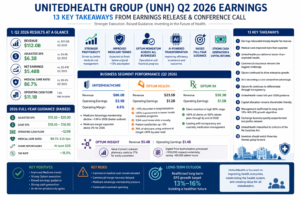
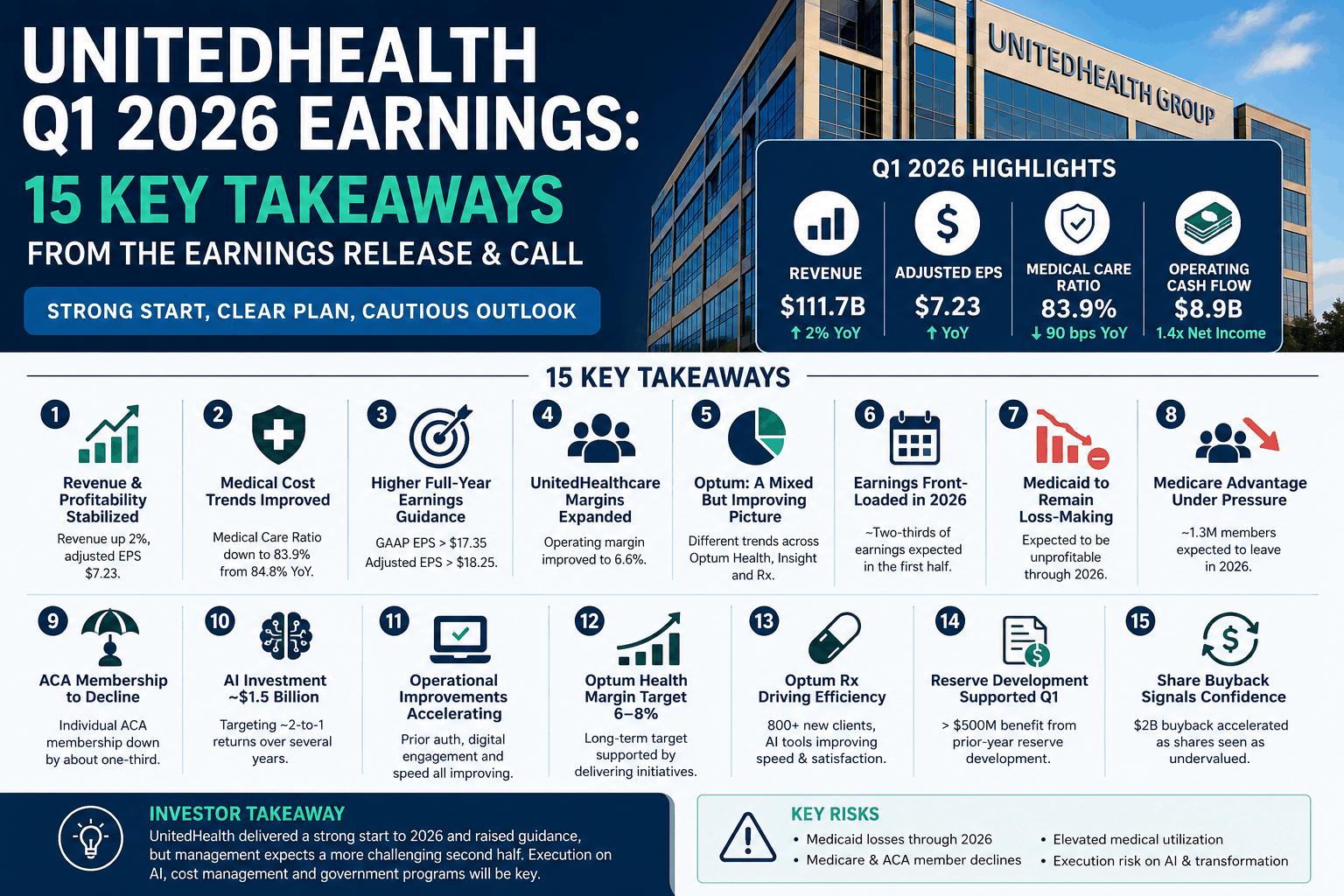
UnitedHealth reported first-quarter revenue of $111.7 billion, up 2% year over year, while GAAP diluted EPS increased to $6.90 and adjusted EPS reached $7.23.

Operating income totalled $9.0 billion, and operating cash flow reached $8.9 billion, or roughly 1.4 times net income, demonstrating strong cash generation despite continued investments.

These results suggest the business has largely stabilised after the operational disruptions experienced during 2025.

2. Medical Cost Trends Finally Improved

One of the most encouraging developments was the improvement in the Medical Care Ratio (MCR).

The MCR declined to 83.9%, down from 84.8% a year earlier, reflecting stronger medical cost management and favourable reserve development.

Lower medical costs directly support insurer profitability, making this one of the quarter’s biggest positives.

However, management later cautioned investors that this improvement should not be viewed as a permanent new trend.

3. Management Raised Full-Year Earnings Guidance

UnitedHealth increased its outlook for 2026, now expecting:

  • GAAP EPS greater than $17.35
  • Adjusted EPS greater than $18.25

A raised outlook typically signals management confidence in execution despite ongoing healthcare industry challenges.

4. UnitedHealthcare Continued to Expand Margins

UnitedHealthcare generated:

  • $86.3 billion revenue
  • $5.7 billion operating earnings
  • Operating margin improved to 6.6% from 6.2% last year.

Pricing actions across commercial and government businesses helped offset persistent healthcare utilisation trends.

Community & State revenues grew 4%, although Medicare membership continued to decline.

5. Optum Became the Biggest Mixed Story

Optum generated:

  • $63.7 billion revenue
  • $3.3 billion operating earnings

Yet each division told a different story.

Optum Health experienced lower revenues due to fewer value-based care members.

Optum Insight experienced margin pressure from technology investments.

Optum Rx maintained revenue growth but earnings softened because of lower prescription volume tied to UnitedHealthcare membership attrition.

While headline numbers appeared mixed, management explained much more during the earnings call.

6. The Earnings Call Revealed That Q1 Was Not a Normal Quarter

Perhaps the biggest disclosure absent from the press release was management’s explanation that 2026 earnings will be heavily weighted toward the first half of the year.

Executives explained that:

  • roughly two-thirds of annual earnings are expected during the first half;
  • UnitedHealthcare profits are particularly front-loaded; and
  • medical cost ratios will rise meaningfully during the second half.

This provides important context for investors who might otherwise annualise Q1 performance.

Why it matters: Q1 likely represents one of the strongest quarters of the year rather than the new baseline.

7. Medicaid Remains the Company's Biggest Operational Challenge

The earnings release noted higher Community & State revenues but never disclosed that Medicaid operations are expected to remain loss-making throughout 2026.

During the conference call, management explained:

  • reimbursement rates remain inadequate,
  • state negotiations continue,
  • only gradual improvement is expected,
  • meaningful recovery may not arrive until 2027.

This represents one of the most significant call-only disclosures.

8. Medicare Advantage Pressures Are Far From Over

The press release discussed declining Medicare membership.

The conference call added much more detail.

Management now expects:

  • approximately 1.3 million Medicare Advantage members to leave during 2026;
  • pricing assumptions to reflect roughly 10% medical-cost trend;
  • utilisation remains elevated although broadly tracking expectations.

While pricing appears to be catching up with costs, Medicare Advantage remains a challenging market.

(adsbygoogle = window.adsbygoogle || []).push({});

9. The Individual ACA Business Is Being Intentionally Reduced

Another disclosure absent from the press release was management’s expectation that Affordable Care Act membership will shrink by roughly one-third during 2026.

Rather than chasing growth, UnitedHealth is focusing on markets where pricing better reflects medical risk.

This suggests profitability is taking priority over enrolment growth.

10. AI Investment Is Much Larger Than Investors Knew

The earnings release simply referred to “substantial AI investments.”

The conference call quantified them.

Management plans to invest nearly $1.5 billion in AI initiatives during 2026.

The investment spans:

  • internal productivity,
  • claims processing,
  • consumer engagement,
  • Optum Insight software,
  • automation,
  • cybersecurity.

Executives also targeted approximately 2-to-1 returns on these investments over time.

This was one of the call’s most significant new disclosures.

11. Operational Improvements Are Becoming Measurable

Management shared several operating metrics not included in the earnings release.

Examples included:

  • approximately 95% of prior authorisations now submitted electronically;
  • about half processed instantly;
  • more than 90% approved within one business day;
  • medical prior authorisations expected to decline more than 30% by year-end.

The company also highlighted:

  • 73 million digital consumer visits during the quarter;
  • more than 80% of customer interactions now occurring digitally.

These metrics suggest the company’s operational transformation is becoming measurable rather than aspirational.

12. Optum Health Has a Clear Long-Term Margin Target

Although Optum Health reported only 4.7% operating margin, management disclosed a long-term objective of 6% to 8%.

Executives pointed to:

  • reduced skilled nursing admissions,
  • higher physician productivity,
  • improved scheduling,
  • operational redesign.

These initiatives are expected to gradually rebuild margins over several years.

(adsbygoogle = window.adsbygoogle || []).push({});

13. Optum Rx Is Quietly Improving Operations

Headline earnings suggested weakness.

The conference call painted a more balanced picture.

Management revealed:

  • over 800 new clients onboarded,
  • AI reduced call-centre volume by roughly 25%,
  • prescription approval times fell dramatically,
  • patient satisfaction exceeded 95%.

These operational improvements were largely absent from the earnings release.

14. Reserve Development Helped Q1 Results

The earnings release referenced favourable reserve development but offered little detail.

Executives later disclosed that prior-year reserve development contributed more than $500 million during the quarter.

Importantly, management stressed it was not assuming similar benefits would continue throughout the year.

This helps explain why executives repeatedly cautioned investors against extrapolating first-quarter earnings.

15. The Share Buyback Was Also a Confidence Signal

UnitedHealth announced plans to repurchase at least $2 billion of stock.

During the call, management explained the programme was accelerated because leadership believed the shares were trading below intrinsic value.

That reasoning never appeared in the earnings release.

While buybacks alone do not guarantee future performance, management’s willingness to accelerate repurchases often reflects confidence in long-term value.

Thank you for reading this post. If you enjoy this post, please share it with your friends or family members. Let’s get life transformed together! Many thanks.

Share on facebook
Share
Share on whatsapp
Share
Share on telegram
Share
(adsbygoogle = window.adsbygoogle || []).push({});

Leave a Reply

Your email address will not be published. Required fields are marked *

Trending Posts

Copyright 2021 © MR Life Changer | Powered by www.mrlifechanger.com

For business collaboration/enquiries, please contact: mr.life.changer9@gmail.com