[mashshare shares="true" align="left"]
Share on facebook
Share
Share on whatsapp
Share
Share on telegram
Share
(adsbygoogle = window.adsbygoogle || []).push({});

Maybank FY2025 Earnings Highlights: 10 Key Growth Drivers and Guidance Investors Should Watch

Maybank FY2025 Earnings Highlights and Growth Analysis

Malayan Banking Berhad delivered resilient FY2025 earnings results despite a challenging regional banking environment marked by lower interest rates, global uncertainty, and slower loan growth across ASEAN. The bank reported stronger profitability, improving asset quality, robust fee income growth, and stable margins while also launching its new long-term strategic roadmap, ROAR 30.

For investors seeking insights into Maybank earnings highlights, earnings analysis, growth outlook, and management guidance, the latest FY2025 results reveal a bank focused on disciplined execution, digital expansion, wealth management growth, and regional scaling opportunities.

Below are the 10 most important takeaways from Maybank’s latest earnings report and investor presentation.

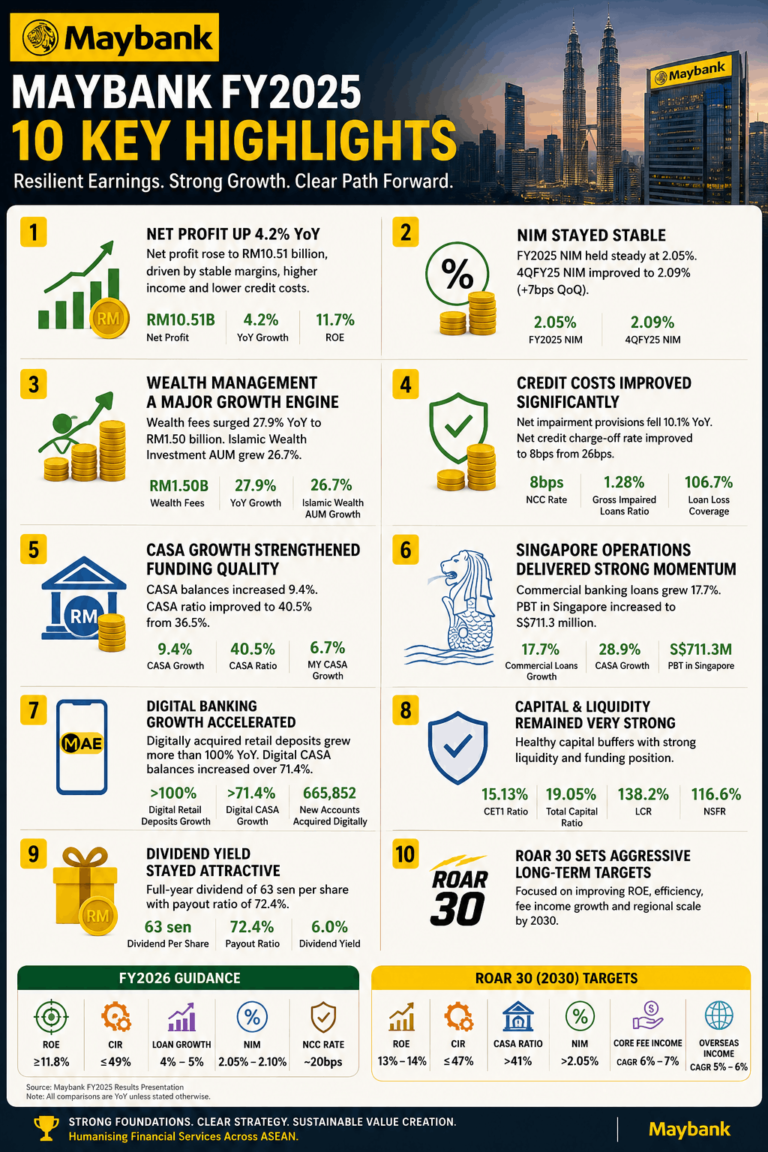
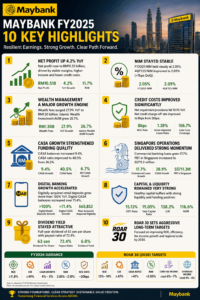
Maybank reported FY2025 net profit of RM10.51 billion, representing a 4.2% year-over-year increase. Profit before tax also rose 4.6% to RM14.33 billion, reflecting resilient operational execution and lower credit costs.

The earnings growth was primarily supported by:

  • Stable net interest margins
  • Stronger fee income
  • Lower impairment charges
  • Improved operating efficiency

EPS increased to 87.1 sen from 83.6 sen in FY2024, while return on equity improved to 11.7% from 11.1%.

For investors, the stronger ROE signals improving capital productivity and healthier profitability trends across the franchise.

2. Net Interest Margin Stayed Stable Despite Rate Pressure

One of the most important positives from Maybank’s earnings results was the stability of its net interest margin (NIM).

FY2025 NIM remained steady at 2.05%, despite rate cuts and margin pressure across regional banking markets. Even more encouraging, fourth-quarter NIM improved 7 basis points quarter-over-quarter to 2.09%.

This indicates:

  • Better funding optimization
  • Improved CASA mix
  • Effective liquidity management
  • Stable lending spreads

In a lower-rate environment, maintaining margin stability is a key earnings quality indicator for banks.

Management also guided FY2026 NIM to remain between 2.05% and 2.10%, suggesting continued confidence in balance sheet management.

3. Wealth Management Became a Major Growth Engine

Maybank’s wealth management business delivered one of the strongest growth performances across the group.

Key highlights included:

  • Wealth fees surged 27.9% YoY to RM1.50 billion
  • Islamic Wealth Investment AUM increased 26.7%
  • Strong investment and bancassurance income growth
  • Improved fee-based revenue diversification

The bank is increasingly positioning wealth management as a strategic earnings driver under its ROAR 30 roadmap.

This is important because:

  • Wealth fees are higher-quality recurring income
  • Fee businesses reduce reliance on interest income
  • Regional affluent wealth trends in ASEAN remain favorable

The accelerating shift toward wealth and investment services could improve Maybank’s long-term earnings mix and valuation quality.

4. Credit Costs Improved Significantly

Maybank delivered substantial improvement in asset quality during FY2025.

Key credit metrics included:

  • Net impairment provisions fell 10.1% YoY
  • Net credit charge-off rate improved to 8bps from 26bps
  • Loan loss coverage remained healthy at 106.7%
  • Gross impaired loans ratio stood at 1.28%

The lower provisions were partly driven by:

  • Completion of a major Malaysian corporate restructuring exercise
  • Non-retail portfolio recoveries
  • Improved portfolio performance across key markets

This significantly boosted earnings quality and profitability.

However, management also warned of potential future pressure from:

  • MSME portfolios
  • Consumer loans in Indonesia
  • External macroeconomic risks

Investors should monitor whether the exceptionally low 8bps NCC normalizes closer to management’s FY2026 guidance of around 20bps.

5. CASA Growth Strengthened Funding Quality

Maybank reported strong deposit franchise momentum during FY2025.

Highlights included:

  • CASA balances increased 9.4%
  • CASA ratio improved to 40.5%
  • Singapore CASA grew 28.9%
  • Malaysia CASA increased 6.7%

The stronger CASA mix helped Maybank:

  • Defend NIM
  • Lower funding costs
  • Improve liquidity resilience
  • Support long-term profitability

For banks, CASA growth is one of the most important structural profitability drivers because low-cost deposits improve earnings durability.

The improvement to a 40.5% CASA ratio also positions Maybank well against regional peers.

(adsbygoogle = window.adsbygoogle || []).push({});

6. Singapore Operations Delivered Strong Momentum

Singapore emerged as one of Maybank’s strongest-performing markets.

Key Singapore highlights included:

  • Loans grew 5.0%
  • Commercial banking loans surged 17.7%
  • CASA expanded 28.9%
  • PBT increased to S$711.3 million

The Singapore business benefited from:

  • Improved liquidity management
  • Stronger lending demand
  • Better funding costs
  • Continued regional trade activity

Management expects stronger loan growth from:

  • Construction
  • Property sectors
  • SME capex recovery
  • Regional trade normalization

Singapore remains a critical strategic growth market for Maybank’s regional ASEAN expansion ambitions.

7. Digital Banking Growth Accelerated Rapidly

Digital banking and customer acquisition trends remained very strong.

Maybank reported:

  • More than 100% growth in digitally acquired retail deposits
  • Over 71.4% growth in digital CASA balances
  • 665,852 new accounts acquired digitally

The bank also continued investing heavily in technology under its M25+ strategy:

  • RM1.24 billion invested
  • 82% allocated toward tech-for-business initiatives

Digital transformation is becoming increasingly important for:

  • Cost optimization
  • Customer acquisition
  • Fee monetization
  • Cross-selling opportunities

This supports management’s long-term ambition to improve its cost-to-income ratio below 47% by 2030.

8. Capital and Liquidity Remained Extremely Strong

Maybank ended FY2025 with very healthy balance sheet strength.

Key capital metrics:

  • CET1 ratio: 15.13%
  • Total capital ratio: 19.05%
  • Liquidity Coverage Ratio: 138.2%
  • Net Stable Funding Ratio: 116.6%

The bank also maintained:

  • Strong dividend sustainability
  • Regulatory flexibility
  • Growth funding capacity
  • Economic shock absorption capability

Importantly, Maybank issued RM4.8 billion of subordinated debt ahead of future redemptions while optimizing risk-weighted assets.

Strong capital buffers remain especially important given ongoing global economic uncertainty and evolving banking regulations.

(adsbygoogle = window.adsbygoogle || []).push({});

9. Dividend Yield Stayed Attractive at 6%

Maybank continued rewarding shareholders with strong dividend payouts.

FY2025 dividend highlights:

  • Full-year dividend: 63 sen per share
  • Dividend payout ratio: 72.4%
  • Dividend yield: 6.0%

The payout reflects:

  • Strong earnings durability
  • Healthy capital buffers
  • Confidence in future profitability

For income-focused investors, Maybank remains one of the more attractive dividend banking stocks in ASEAN due to its combination of:

  • Stable profitability
  • High payout ratio
  • Strong liquidity
  • Regional diversification

Dividend sustainability will remain a major investment attraction for institutional and retail shareholders alike.

10. ROAR 30 Sets Aggressive Long-Term Profitability Targets

The most strategically important announcement was the launch of Maybank’s new “ROAR 30” roadmap.

Key 2030 targets include:

  • ROE of 13%–14%
  • Cost-to-income ratio below 47%
  • CASA ratio above 41%
  • Core fee income CAGR of 6%–7%
  • Overseas income CAGR of 5%–6%

The strategy focuses on:

  • Wealth management leadership
  • Transaction banking growth
  • Regional ASEAN expansion
  • Islamic banking leadership
  • Technology and AI adoption
  • Productivity optimization

Management believes ASEAN’s growing economic importance will create significant long-term banking opportunities.

If successfully executed, ROAR 30 could materially improve Maybank’s earnings profile and valuation multiple over the next five years.

Conclusion

Maybank’s FY2025 earnings analysis shows a bank entering its next strategic cycle from a position of strength.

The company delivered:

  • Stable margins
  • Improving profitability
  • Strong fee-income growth
  • Better asset quality
  • Strong liquidity
  • Attractive dividends

The launch of ROAR 30 also signals management’s confidence in long-term ASEAN banking opportunities, especially across wealth management, Islamic finance, digital banking, and regional corporate banking.

While risks remain around global macro conditions, MSME credit quality, and Indonesia consumer lending, Maybank appears well-positioned to sustain earnings growth and improve shareholder returns over the coming years.

For investors searching for strong ASEAN banking exposure with resilient dividends and improving profitability metrics, Maybank’s latest earnings results reinforce its position as one of the region’s leading banking franchises.

Thank you for reading this post. If you enjoy this post, please share it with your friends or family members. Let’s get life transformed together! Many thanks.

Share on facebook
Share
Share on whatsapp
Share
Share on telegram
Share
(adsbygoogle = window.adsbygoogle || []).push({});

Leave a Reply

Your email address will not be published. Required fields are marked *

Trending Posts

Copyright 2021 © MR Life Changer | Powered by www.mrlifechanger.com

For business collaboration/enquiries, please contact: mr.life.changer9@gmail.com