[mashshare shares="true" align="left"]
Share on facebook
Share
Share on whatsapp
Share
Share on telegram
Share
(adsbygoogle = window.adsbygoogle || []).push({});

VICOM FY2025 Earnings Highlights: 12 Key Takeaways for Investors

VICOM FY2025 Earnings Highlights & Guidance Analysis

VICOM’s latest earnings results for FY2025 (and disclosed 2H2025 performance as a proxy for late-year momentum) show a breakout year driven by Singapore’s ERP 2.0 On-Board Unit (OBU) installation program, while management simultaneously signaled that demand will likely normalize as the OBU wave tapers. Below are the most important VICOM earnings highlights, the numbers that matter, and what they could imply for VICOM’s outlook and stock analysis.

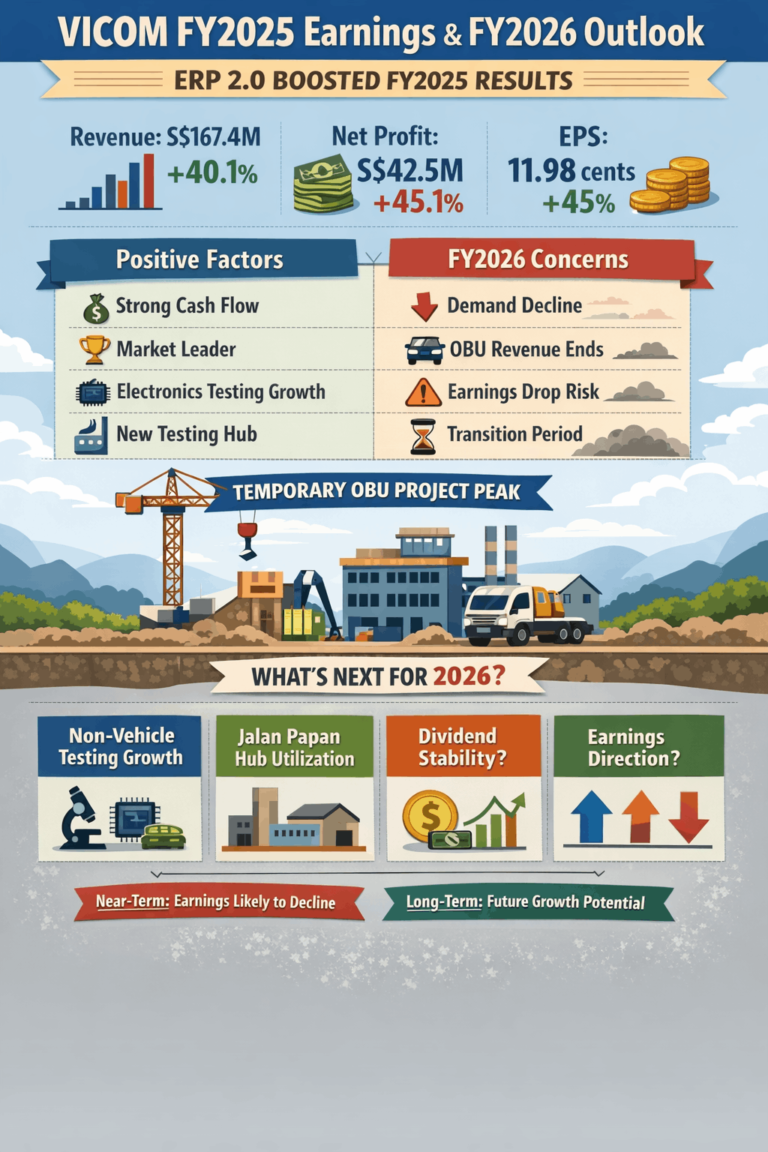
VICOM reported FY2025 revenue of S$167.4m, up 40.1% YoY. The company explicitly attributed the strong year primarily to the OBU installation contribution tied to the Land Transport Authority’s ERP 2.0 migration exercise.

2) Operating profit grew even faster (+49.7%), lifting operating leverage

Operating profit rose to S$51.8m in FY2025, up 49.7% YoY, outpacing revenue growth.

That puts operating margin at roughly 30.9% for FY2025—strong for a testing/inspection services model.

3) Net profit attributable to shareholders surged 45% YoY

Net profit attributable to shareholders reached S$42.5m, up 45.1% YoY.

4) EPS rose 45%—earnings momentum translated cleanly to per-share growth

EPS increased to 11.98 cents from 8.26 cents in FY2024 (+45.0%).

5) Late-year performance was very strong (2H2025)

Because the company disclosed 2H rather than Q4, the best “late-year” lens is 2H2025:

  • Revenue: S$97.6m (+54.4% YoY)

  • Operating profit: S$32.9m (+85.0% YoY)

  • Profit attributable to shareholders: S$26.9m (+77.6% YoY)

(adsbygoogle = window.adsbygoogle || []).push({});

6) VICOM installed more than 251,000 OBUs—execution leadership mattered

VICOM highlighted that it installed >251,000 OBUs, the highest among four authorised partners.

7) Vehicle inspection market share stayed dominant at 72.3%

Even amid OBU workload, VICOM maintained market leadership in vehicle inspection with a 72.3% market share.

8) Non-vehicle testing benefited from AI-era electronics demand and de-risking

VICOM noted that non-vehicle testing delivered good results despite uncertainty, supported by:

  • stronger manufacturing and construction activity, and

  • buoyant electronics cluster demand tied to AI-related semiconductors, servers, and server-related goods, plus supply-chain de-risking.

9) Costs rose sharply—especially subcontracting—reflecting OBU intensity

The filing shows the cost profile behind the growth:

  • staff costs increased, and

  • contract services (including subcontractor fees) surged, consistent with OBU project execution.

10) CapEx stepped up to S$39.0m—investment phase is underway

FY2025 CapEx (vehicles, premises & equipment purchases) rose to S$39.0m from S$11.9m in FY2024.

Management’s commentary points to strategic capacity build-out, including the integrated Jalan Papan hub, intended to expand vehicle inspection capacity and house advanced non-vehicle testing services.

11) Free cash flow stayed positive even with heavy reinvestment

Cash flow from operations was S$58.2m. After CapEx of S$39.0m, implied free cash flow is roughly S$19.2m (simple CFO minus CapEx).

Cash ended at S$57.9m (slightly down YoY), with the company noting net cash outflow after dividends.

12) Guidance: demand expected to decrease overall—but mix should shift toward new testing

Management outlook was clear:

  • Overall demand is expected to decrease in the year ahead,

  • Vehicle testing and related work is expected to taper off as OBU installations substantially completed in 2025,

  • Non-vehicle testing demand is expected to increase as the Jalan Papan hub becomes fully operational in 2H (of the coming year).

(adsbygoogle = window.adsbygoogle || []).push({});

The simple takeaway

VICOM’s FY2025 earnings results delivered standout growth—revenue +40%, operating profit +50%, and EPS +45%—driven by exceptional execution on the ERP 2.0 OBU program while maintaining leadership in vehicle inspection.

The company’s guidance signals a likely near-term demand step-down, making FY2026 a transition year where the market will focus on the pace of non-vehicle testing expansion and the returns on the Jalan Papan hub investment.

Thank you for reading this post. If you enjoy this post, please share it with your friends or family members. Let’s get life transformed together! Many thanks.

Share on facebook
Share
Share on whatsapp
Share
Share on telegram
Share
(adsbygoogle = window.adsbygoogle || []).push({});

Leave a Reply

Your email address will not be published. Required fields are marked *

Trending Posts

Copyright 2021 © MR Life Changer | Powered by www.mrlifechanger.com

For business collaboration/enquiries, please contact: mr.life.changer9@gmail.com